


Widow’s Bay
“Lodging”
April 29, 2026
It’s night — deep night — and the charming Widow’s Bay church’s bell tolls: 9 times.


The next day, Tom and Patricia are in the car, Patricia examining a box full of new Widow’s Bay visitors’ brochures she and Tom had made while feeling bullish about the upcoming tourism season thanks to the glowing New York Times piece about their little town.


Unfortunately, the printers left out Patricia’s poem, but Tom, looking to distract her, asks her to “read it again!” Patricia obliges, reading from Arthur’s article: “New England’s Best Kept Secret”: “Don’t look for a Starbucks here …” But Tom urges her to get to the Martha’s Vineyard part:
“Widow’s Bay is the next Martha’s Vineyard.” That’s all it says about that. It’s not really a “part.”
Tom and Patricia arrive at Widow Bay’s one coffee shop to try out the Starbucks replacement, and the owner complains that no one is ordering any coffee. Tom promises the tourists will arrive that weekend, and he will make his money back.
Tom’s delight is interrupted, however, when a cop car speeds by, sirens blaring. Tom and Patricia follow, and are led to the Breakwater Inn, where a crowd has amassed to watch a drunken Wyck attempt to board up the hotel over the owner’s protestations. Wyck howls that they can’t allow people to stay at the Inn.
The inn is not right!
Wyck and Kurt, the owner of the inn, tussle over Wyck’s hammer, ultimately ending with Wyck tumbling down the porch. Sheriff Bechir gathers Wyck up, urging him to sleep it off. But Wyck continues to protest that the inn is haunted, the mayor is a fool, and he’s going to get them all killed.
Sheriff Bechir manages to wrangle Wyck into the back of his SUV, but Wyck rolls down the window to continue yelling at Tom, to Tom’s irritation:
How is he able to roll down the window?

Wyck yells that Tom would never stay in the hotel by himself, he’s only doing all of this for the money, and that he’s not one of them, he’s a coward!
Being accused of being a coward by Wyck in particular is a sore spot for Tom, who yells back, “FUCK YOU, YOU DUMB HICK!”
He regrets it immediately.


As Sheriff Bechir drives Wyck away, Tom insists to the crowd that Wyck just needs to sleep it off, while Kurt tries the door that Wyck just tried to nail shut:


Later, at the Salty Whale, Tom is picking up dinner when he’s joined by Reverend Bryce. The good Reverend notes that he heard Tom had quite the day, and Tom grouses about how hard it was to land that New York Times article, and there’s not a bit of gratitude from anyone. Reverend Bryce notes that Wyck has “not had the easiest go of it,” and that people in Widow’s Bay fear change. Reverend Bryce makes some noise about how when the Lord gathers a herd, he calls a shepherd, James 4:6, blah blah Bible blah.
Reverend Bryce invites Tom over for a drink, but he declines, before noting that the Reverend should lock the church up at night. The Reverend wonders what he’s talking about, and Tom casually mentions that the bell was rung in the middle of the night, waking him, Patricia, and Rosemary up the night before. Tom suggests that it was probably just a teen prank — most likely performed by his own son — and he’ll talk to him about it.
The Reverend whispers that the bells ringing is “impossible,” before stumbling out of the restaurant just as Tom’s food arrives.
Tom confirms that the hated Kathy didn’t bag up the food before turning to leave, only to have one of the Townies spit out, “DUMB HICK” at his back.
Tom sighs heavily before turning around to tell the assembled that he didn’t mean it, but also, Wyck is wrong, and there’s nothing wrong with the Inn; it’s not haunted.
The crowd then challenges Tom to spend the night there: they’ll all chip in. Tom agrees, and they specify he has to stay in the Captain’s Suite: he lost his mind, killed his family with an axe.
Of course we then named a suite after him.
Tom wonders if there’s anything else he should be aware of, and they deliver a litany:
- “The Ungrateful Hortence Fitzgerald,” an ugly woman who fled her wedding, backed out a window and fell to her death. Today, if you repeat “ugly Hortence,” you’ll see her reflection.
Tom:
You know, I’m gonna ask that we start questioning these narratives. There’s misogyny in the air. More than a whiff.
But also, he needs to know about:
- The New Year’s Eve, 1962, disaster
- John Reynold’s head in the dumbwaiter
- That clown killer of ’51 — the murderer who dressed as a clown, not a guy who murdered clowns
- And the crawl space, which Rosemary suggests Tom explore.
All the way to the back, too. Not halfway, pussy.
Tom agrees to spend the entire night in the hotel, locked in by the owner, and in exchange, the locals will leave the tourists alone. Deal? Deal. But as he makes his way out of the Salty Whale, Lonnie the harbormaster stops him and whispers, “Don’t do it.”
Elsewhere, Reverend Bryce rushes back to the church and scampers up the ladder to the belfry to inspect this bell that Tom claims was ringing in the middle of the night:

Hmm.
But Tom heads home and informs his son, Evan, that he’s going to be staying at the Inn overnight to make sure that everything is in order before the tourists arrive, and Evan will be staying over at his elderly secretary Ruth’s house for the night. At first Evan refuses, before being like, “AKSHULLY, THAT’S A GREAT IDEA.” Tom quickly realizes that Evan is planning some shenanigans, but what can he do?
For some reason, Tom has Patricia drop him off at the Inn rather than just drive himself, I suppose so she can mention that the Inn freaks her out before wishing him good luck.
Inside, Tom rings the bell and then takes in some of the artwork decorating the lobby, notably this piece:


When Kurt, the owner of the Breakwater, finally appears, he assures Tom that he took down some of the more “provocative” art.


Kurt then hands him a camcorder, explaining that the townies want him to film his stay, to Tom’s great irritation.
Leading him to his room, Kurt points out the honor bar, adding that Tom is expected to write down whatever he drinks, and pointing out that there’s a security camera, so he’ll know what Tom took.
Hmm. That’s not really an honor system.
Once Tom enters the Captain’s Suite, Kurt notably refuses to step inside with him, opting instead to kick Tom’s suitcase over the threshold, and tells him that if Tom needs anything, he can reach him at his house.
Back at the church, Reverend Bryce is in a closet, surrounded by papers, files? and reading one letter in particular:

And over at the police station, Sheriff Bechir is on the phone, assuring his wife that while they can’t leave the island at the end of July, they will leave by Labor Day. From the holding cell, Wyck asks if Bechir is moving, and when he confirms he is, Wyck assures him that it’s the smart choice.
As for Tom and the Inn, he decides to take in a little TV and is greeted with this welcome video:

Tom becomes distracted by the lighthouse shining into his room, and closes the curtains before deciding to go downstairs and explore the honor bar. There, he checks out the bookcase (and here is where I usually note that bookcases are often important sources of foreshadowing or easter eggs, but I gotta be honest, I’m not seeing anything here. You?):

However, underneath the books are a number of curious games:
- A board game called “Daddy’s Home!” featuring a fully psychotic looking “Daddy” on the box:

- A board game called “She Shouldn’t Have Said That”:

- A simple game of “Teeth”:


- And finally a card game called “RUN”:


Tom, having had just about enough of this nonsense, pours himself a glass of brown as Kurt’s disembodied voice orders him to fill out the drink log.
And now it’s time to get on with the ghost investigation. First up, Tom calls out for “Ugly Hortensce” three times, to no avail.
He locks himself in the closet and counts to five. Aside from the door sticking a little, nothing.
He then goes downstairs to explore the crawl space in the basement, but after taking a cursory look at it, Tom declares, “Not a chance.” And honestly, do not blame him.
When Tom returns to his room, he decides to call Ruth’s to check on Evan, and while he waits in vain for Ruth to put his teenage son on the phone, he notices that the fan is on (he did not turn it on) and the curtains are open once again. Tom closes the curtains, again, and hears a faint sound coming from his bathroom.
Upon investigating, he hears from his vent what sounds like a raucous party and people counting down from “eight … seven … six … five …” As the crowd yells, “HAPPY NEW YEAR!” there is what sounds like … a roar? A growl? followed by screaming.
A loud thump distracts Tom, and he trepidatiously sticks his head out of his room to yell, “Hello” into the darkened hallway. Suddenly a figure steps into the hallway, and when the lights turn on, he’s revealed to be another man in shirtsleeves and a tie, seemingly as alarmed to see Tom as Tom is to see him. Tom is confused as to what the man is doing there, Kurt didn’t tell him anyone else would be staying there for the night, but the man brushes this off before introducing himself as William. William suggests they get a drink at the honor bar, but Tom declines and returns to his room.
Once inside, he tries to watch TV again, only to find there is only the one channel with the welcome video, this time with bonus shadow figure:

But before Tom can make sense of this, the television experiences some sort of surge, and pops off in a shower of sparks, causing Tom to cry out in surprise.
Tom is more amenable to that drink now, and he and William head down to the lounge where, over glasses of bourbon, William tells Tom that he’s been to Widow’s Bay before, and it sure is nice to be able to order a cappuccino this time. Tom is happy to hear this, and William reveals even more good news for the mayor: he’s in town to inspect the dock for the planned expansions. William observes that his constituents must be pretty happy with Tom, but Tom dismisses this, noting that they don’t make it easy on him, adding that he ran for mayor uncontested.
The two men find themselves playing “Daddy’s Home,” which, from the sound of it, involves the players making their way across the board whilst dodging a violent, probably drunken father.
William: “Uh-oh. Daddy’s younger boss yelled at him today.”
Tom: “Roll… Roll to see if the neighbor is home.” … Yes! Saved by the neighbor.
William: “Daddy had a bad day. Go back six spaces.” … Oh, man. I’m in the basement.
Soon, Tom is telling William his story: Dad was a local from Widow’s Bay, Mom from the mainland. They couldn’t make it work, and he grew up living with her in Massachusetts and spending his summers on the island. Tom dreaded those summers. Not because his father was the worst, but it was just a lot of walking on eggshells. Tom moved back full time when his father became sick, met his wife, and has been there ever since.
Tom further elaborates that when he was a kid, his father would come home after a few drinks telling “horror stories” about the island, stories he was too young to hear, and he called Tom “soft” once when Tom was only six. Tom sighs that the only thing the island is cursed with is alcoholism, and William suddenly turns dark:
You gotta be careful. They’ll drag you down with them if you let ’em. Fuck useless ass-backwards, small-brained, townie hicks. Let ’em all rot in hell and watch ’em all fucking burn.
Tom chuckles uncomfortably as William apologizes and suggests he might have had too much to drink. William assures Tom that he’s a good mayor and that there is no such thing as ghosts. In fact, Tom should finish off the townies’ list and show them “who’s in charge.”
With that, William excuses himself to bed, and Tom heads down to the basement to take a look at that crawlspace again. Gathering his courage, he heads into the tight tunnel and makes his way to the back, where he begins videotaping himself.
He’s interrupted by a sound behind him, and panicked, calls out asking if it is William. A pair of legs appears in the opening of the crawlspace, and soon, William is asking Tom if he needs any help in there. Tom insists he does not, that he’s coming out, but before he can leave the space, William has entered the space, in full clown makeup, scurrying towards Tom.
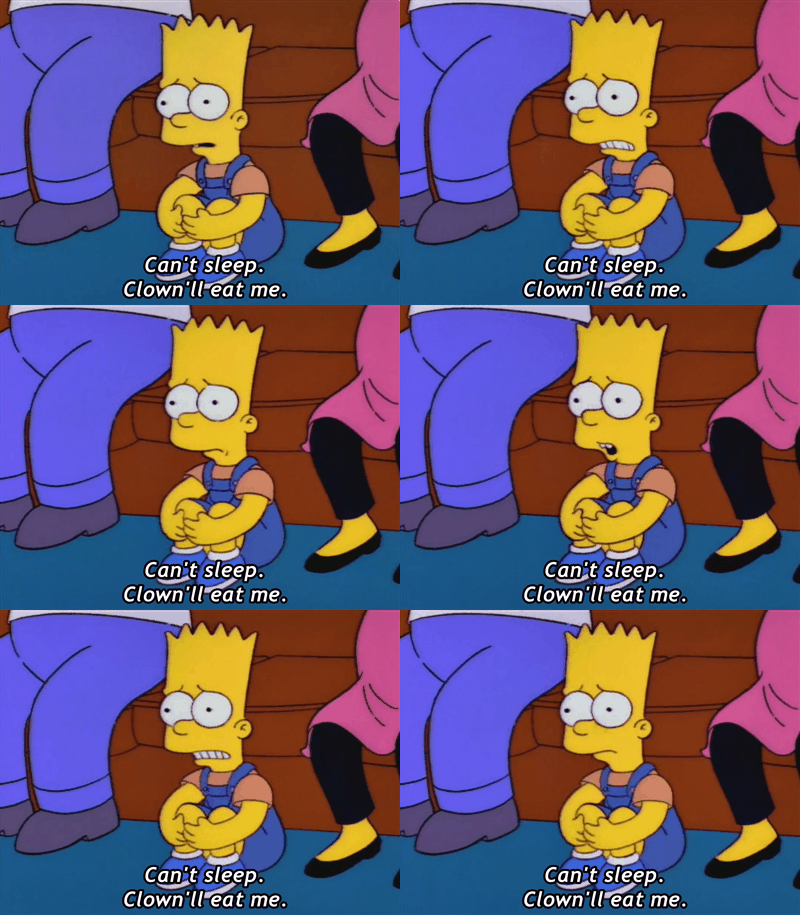

Tom, screaming, backs further into the crawlspace until he’s up against a skeleton who appears to be wearing a very similar shirt to the one Tom is wearing.
With that, Tom wakes up in the Captain’s Suite. It’s morning, and those curtains, they’re open again.
Sometime later, Kurt the innkeeper is insisting to Tom that no one else was with him last night, and Sheriff Bechir confirms that there was no one in the crawlspace. As the security footage reveals no one else with Tom in the lounge, Tom continues to insist that his name was “William.” That’s when Wyck joins the group, noting that Tom met with “Willy the Clown,” and tsking that after all that, Tom is still going to let people come to the island.
Kurt is over Wyck’s nonsense: he’s put every penny he has into the inn, and it’s perfectly fine.
So Wyck challenges Kurt to go into the Captain’s Suite if it’s so safe and there’s nothing to be afraid of.
Kurt, clearly terrified, hesitantly agrees. As Wyck, Tom, and Sheriff Bechir stand in the hallway, they have him go into the room alone for 10 seconds with the door closed.
When they open the door, Kurt is screaming at them that they agreed to only 10 seconds, and the other men are confused: how long did he think he was in there? They challenge him to go back in for 30 seconds, and Kurt asks if he can have some food first.
As they wait the thirty seconds, Wyck implores Tom: he’s seen it with his own two eyes now. The island is waking up, and it is dangerous; Tom must call off the visitors. When they reopen the Captain’s Suite, Kurt is despondent, and the room is trashed. But Sheriff Bechir, he notices that the wallpaper is peeling back, and underneath: black mold. Kurt insists that the mold must have made Tom hallucinate, before promising he can have the room remediated in 72 hours.
With that, the men take their leave. As Tom gets into Patricia’s car, she asks him how it went. “Fine,” he lies.
ALRIGHT! So let’s once again start with the horror references packed into this episode, of which there are many.
Starting with the most superficial and least relevant to the episode: do you recognize the house below?

This house served as the inspiration for the Edward Hopper painting, “The House by the Railroad”:


Which, from this angle, is immediately recognizable as the Psycho house.


The episode also alludes to the Stephen King short story and 2007 John Cusack movie, 1408. In the story, a skeptical author is basically dared to stay in a supposed haunted hotel, in a specific room, where time is known to move differently. Once in the room, the protagonist begins to see ghosts and has other terrifying experiences. When he attempts to leave the room, he discovers that he is trapped. He manages to escape the room by setting a fire, but then has long-lasting trauma as a result of the experience.
Here, obviously, the bones of the story are similar: a skeptic spends the night in a haunted hotel, and soon has to come to terms with the fact that there is something supernatural happening. Additionally, the inn owner, Kurt, seems to have his own 1408 experience twice, at the end of the episode.


There’s another spooky hotel movie that this episode leans on much more heavily, though: The Shining. The set designer also said that the damask wallpaper throughout the hotel was a nod to The Shining, though I’m having a hard time finding a shot that corresponds in the movie. (The red and orange carpet is a much more iconic pattern from the film.) But from a cursory glance, it does look like there might be some sort of damask in the ballroom in the bar scene where Jack has a drink with the ghostly bartender, Lloyd.

Which, of course, is similar to Tom having a drink with William, the ghost.
There are several other Shining references, including the story of the Captain for whom the suite was named, who killed his family with an axe.
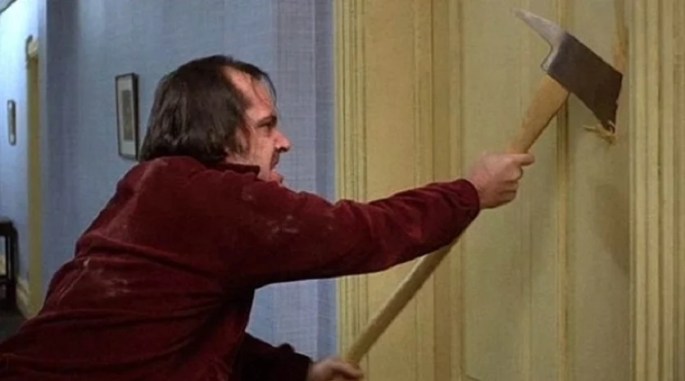

And the New Year’s Eve party that Tom hears through the vent:


And this might be a stretch, but is Tom dressed like Jack Torrance? Or is he just dressed like a dude?


As for another Stephen King reference, Willy the Clown is clearly a not-so-subtle nod to Pennywise the Clown from It:


(I have a whole other diatribe about a supposed real-life clown/alien/monster thing that appeared to two children in England back in 1973 that I legit think might have been at least a partial inspiration for Pennywise, but it has nothing to do with Widow’s Bay, so I’ll just direct you to look up “The Sandown Clown” or “Sam the Sandown Ghost” or “All Colors Sam” on your own if you’re interested. It’s super weird.)
And this might be another stretch, but the end of the episode, in which it is revealed that there is mold behind the peeled-back wallpaper, reminded me of the classic horror novella, The Yellow Wallpaper. In that story, a woman is locked away in a small room by her husband, and she proceeds to lose her mind, hallucinating a woman creeping on all fours within the design of the wallpaper. Believing she must free the woman, the protagonist begins peeling the paper off the wall. When her husband eventually checks on her, he finds his wife crawling on all fours while saying, “I’ve got out at last… in spite of you.”
Again, it might be a stretch, but it feels like Kurt, in his madness at being trapped in the Captain’s Suite for some undetermined amount of time in his own mind, peeled the wallpaper back and exposed some sort of truth about the nature of whatever horror is happening here.
As for the symbolism of the episode, let’s begin with the hotel itself as this hub of haunts. Hotels, like the Overlook in The Shinng or The Dolphin in 1408, are classic haunted locations. (True story: I’ve seen a ghost twice, and both times were in the same hotel room but on different visits.) Hotels’ nature as liminal spaces, places where people are passing through from one destination to another, leads to a sense of unease: it is home but not home. Additionally, liminal spaces serve as a symbolic meeting place between worlds. Because it is home but not home, because it is familiar … but not, it is easier for spirits to cross into our world in liminal spaces like hotels, or for our corporeal bodies to slip into some sort of out-of-time space, inhabited by those who spent time in the hotel long ago. Are Willy the Clown and the New Year’s Eve party ghosts, or did Tom slip through time and encounter them in their own timelines?
As for Willy the Clown, why are clowns so fucking scary? There’s actually a lot of psychology behind why some people, including your trusty blogger, find clowns so disconcerting: it has to do with the masking, the forced emotion of the painted face, and their unexpected behavior — it’s difficult to anticipate how they are going to behave because their entire reason d’être is to flout social norms. They symbolize reversing the normal order of things: clowns have in the past been a symbolic inverted image of the king, and served as a substitute sacrifice for those who actually hold power.
But here, I think Willy the Clown represents Tom’s broken childhood. Clowns, like the games that Tom and William play in the lounge, are totems of childhood. And despite being most closely associated with children, games are a heavily loaded symbol representing struggle, conflict, power, and man’s eternal quest to control his own fate.
The games Tom finds in the haunted hotel are horrific: “Teeth,” “Run,” “She Shouldn’t Have Said That,” and most menacingly, “Daddy’s Home.” It is not a coincidence that it is after playing a regressive 1950s-era board game that involves the players trying to avoid a violent alcoholic father that Tom opens up to William about his relationship with his own alcoholic father, who would terrify him with scary stories about the island.

This, of course, ties back to one of the references mentioned above: The Shining, in which Jack Torrance is struggling with and eventually gives in to his own violent and alcoholic nature before trying to kill his wife and son. But it also shines a bright light on why Tom is so resistant to Wyck and his warnings about the island, so much so that he lashes out at him in front of the entire town: Wyck reminds Tom of his father. And it also explains why Tom is willing to take on the townies’ challenge to stay in the hotel: He’s determined to prove to them and his father that the stories about the island that terrified him as a child are nonsense, and that he is not the soft coward that they (and his father) all think he is.
One last note about the “Daddy’s Home” game before I move on: When it’s William’s turn, he reads the instructions: “Daddy had a bad day. Go back six spaces,” before adding, “Oh man, I’m in the basement.”


Note in the bottom right-hand corner of this picture, you can see that the game says: “NO!! Basement is bad. You lose.”

And sure enough, it’s when Tom is in the basement that he encounters Willy the Clown and what appears to be his own skeletonized body:

The underground spaces on this island are proving to be dangerous. You go into the basement, you lose, indeed.
But there’s so much more to untangle, starting with where the episode begins: with the island church at night, the bell tolling nine times.
Obviously, churches are holy spaces, places of worship, sanctuaries: they represent God’s home here on Earth. They also represent a place of sacrifice. In Christian churches, the story of Jesus’ sacrifice is told and retold, and the expectation, or at least the hope, is that attendees will, in turn, make an offering up to God of their sin, their ego, and, if a devout enough believer, of their own lives in service of spreading the word of God.
Now, as for that mysterious bell that rang out nine times despite being locked up to prevent that very thing … Bells are first and foremost a communication device: they are used to signal that something is about to begin, whether it be your day as signaled by your alarm, or that a church service is about to start, calling out to the congregants that it is time to worship. Presumably because of their association with churches, in folklore, bells have gained a reputation for warding off evil spirits, goblins, and fae, and are often used in ceremonies, both in traditional Christian services and in some magical practices in which they are used to cleanse a space.
However, remember that this bell is pealing in the middle of the night, when it should not physically be able to. There are multiple legends from the United Kingdom in particular of “sunken churches,” churches that have been destroyed by one method or another — floods, sunk into the dunes, bad sea captains — whose bells can still be heard tolling on occasion, either as a haunt of the church that once was, or as an omen for some forthcoming cataclysmic event.
And then there’s the number of times the bell rang: nine. Nine is a very spiritually significant number across many cultures, because it is a number of completion: it is the last of the single digits, it represents the tripling of three (which is its own highly symbolic number representing harmony and balance), and it is almost magical in the way that all of its multiples add up to nine. It represents the triple synthesis of mind, body, and spirit, and of the underworld, earth, and heaven.
From the Penguin Dictionary of Symbols: ”
Nine being the last of a series of figures heralds both an end and a fresh beginning, that is to say, a removal to a new plane. This notion of rebirth and germination in association with that of death is, as we have shown, recurrent in the concepts of symbolic properties of the number held in several different cultures. As the last of the numbers in the manifested universe, it starts the phase of transmutations. It gives expression to the end of a cycle, the completion of a journey, the tying of a knot.
The bell is accessed by Reverend Bryce via a ladder, and in fact, there are two ladders in this episode (well, one ladder, and one set of stairs, which Tom takes down to the basement). But symbolically, the stairs and ladder represent the same thing. Ladders and stairways represent a connection between earth and some other non-earthly space, be it the heavens or the underworld. They serve as a way for humans to access a non-human plane, and as such, gain a certain wisdom, literally one rung or step at a time. If a person ascends a ladder or stairs, they are heading towards divine knowledge; and if they descend, they are plumbing the depths of the subconscious, gaining knowledge of the occult, of the darkness.
And, in fact, the descent into the basement is Tom’s first step towards becoming a believer. In fact, the episode itself can be read as both the beginning of Tom’s hero’s journey, and a mini-hero’s journey in and of itself. On the macro level, this is Tom’s literal Call to Adventure: the townies dare him to embark on this adventure in the hotel alone.
But Tom’s time in the hotel can also be read as the hero’s journey in miniature: he’s called to the adventure by the townies to go to the hotel; he crosses the first threshold (without assistance by Kurt as noted above) by checking into the Captain’s Suite; he has his own road of trials in which he enacts all the dares by the townies; there is a failed atonement with the father in which we learn of Tom’s difficult relationship with his father through “Daddy’s Home”; Tom seeks the ultimate boon in the crawl space (and might have gained it — it being knowledge of the true nature of the island — through his experience with Willy the Clown and the vision of his own skeleton); and Tom is eventually rescued from without, via awakening from what he assumes was all but a nightmare.
It’s an incomplete hero’s journey, however. Tom does not become the Master of Two Worlds, and gain Freedom to Live because he ultimately rejects the experience of the journey altogether, willing to accept Sheriff Bechir and Kurt’s explanation that it was merely a mold-induced hallucinatory nightmare, rather than Wyck/The Father’s truth that the island was showing him its monstrosity.
The fact that both might be correct, that the mold might be the means through which the island can communicate its horror/terrorize its inhabitants, is something we can get to in another entry when I haven’t babbled on for five thousand words already.
Hey — I should have mentioned this earlier, but a huge shoutout to Screencapped.net, where I found the screencaps; and to Foreverdreaming.org for their transcripts of this and other TV shows.
Widow’s Bay streams on Apple TV.